

In the current regulatory environment, insurance carriers are facing a “structural shift” in expectations. With NAIC 2026 priorities naming AI model governance, innovation oversight and cyber threats as one of four strategic priorities for 2026, compliance has moved from a back-office function to a direct expression of a carrier’s operational integrity. The other three priorities are capital and investment frameworks, data architecture and predictive analytics, and resilience through regulation and mitigation. However, traditional insurance compliance audits—which often operate as periodic snapshots—frequently create significant “blind spots” between review cycles. To manage modern risks, carriers must transition toward intelligent, risk-driven assurance that provides visibility into their compliance posture between formal audits.
The Compliance Challenges Holding Insurance Carriers Back
Traditional audit methodologies are struggling to keep pace with a dynamic business environment. The pattern is familiar from banking, where the control testing capacity problem has forced the same reassessment for several years. Key challenges include: An expanding, overlapping rulebook. Carriers answer to NAIC model laws and bulletins, to state-specific market conduct requirements, and increasingly to AI guidance that differs by jurisdiction. As of April 2026, 25 jurisdictions had adopted the NAIC Model Bulletin on the Use of AI Systems by Insurers. California, Colorado, New York and Texas run their own AI guidance instead. A periodic audit calendar was not designed for a rulebook that changes state by state.
Manual evidence collection
Most teams still assemble evidence by hand, working through policy documents and claims files individually. The cost is not only cycle time. Transcription errors surface later as premium leakage, or as findings in a market conduct examination.
Fragmented data ownership
Claims systems, underwriting platforms and legacy policy administration were built to run the business, not to evidence it. Assembling a defensible population for testing becomes a project in its own right, before any testing begins.
Blind spots between cycles
A point-in-time audit cannot see the period it does not cover. A control that fails in March may not surface until the next review. By then the exposure has compounded across a full quarter of policies.
Effort concentrated in the wrong place
Most of the audit budget is spent locating and organizing documents. The judgment work that regulators rely on then receives the smallest share of the calendar. 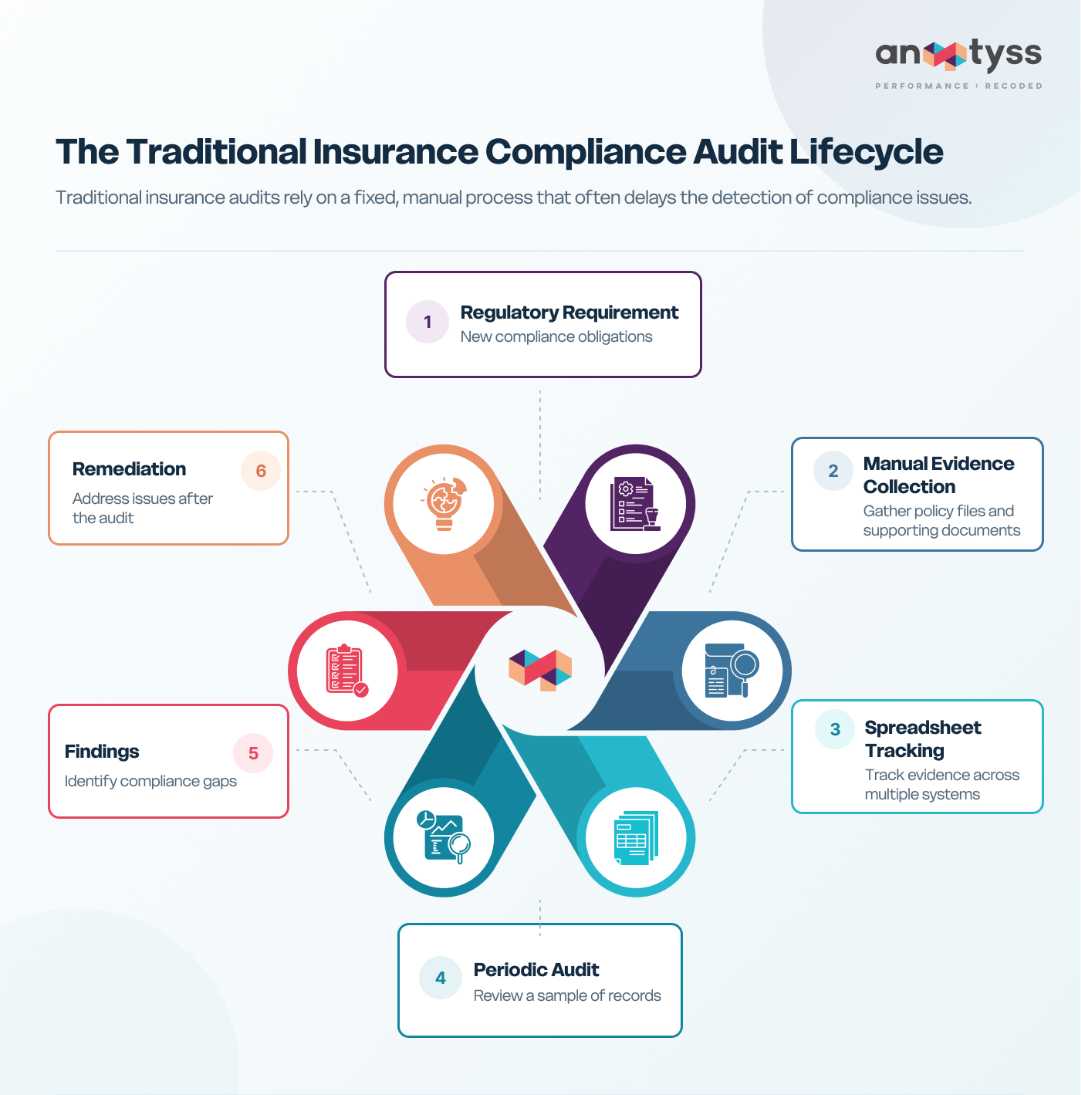
What the Rulebook Actually Requires
It is worth being precise about the obligation this modernization serves. The NAIC Model Audit Rule (Annual Financial Reporting Model Regulation #205) requires three things: audited annual financial statements from an independent CPA, communication of internal control matters identified in the audit, and above defined premium thresholds, Management’s Report of Internal Control over Financial Reporting. The third is an annual management certification that ICFR is effective. ORSA (Model #505) adds the forward-looking own-risk view. Neither rule prescribes a technology, nor requires continuous testing. What they create is an annual attestation.
That attestation is far cheaper to defend when the evidence behind it was captured continuously, rather than reconstructed in the eight weeks before filing. The terminology also matters when briefing an audit committee. The Institute of Internal Auditors distinguishes continuous auditing from continuous monitoring. Continuous auditing is internal audit’s own ongoing, technology-enabled assessment of risk and controls. Continuous monitoring is the management’s responsibility. Confusing the two is a common way for a modernization program to compromise audit independence.
Why Traditional Compliance Audits Can No Longer Keep Pace
As the pace of business accelerates, point-in-time evaluations prove increasingly problematic. Modern insurance risk and compliance management requires a shift toward more frequent, automated insights.
| Traditional Compliance Audits | Modern Compliance Audits |
| Periodic reviews creating blind spots. | Risk-informed visibility between audit cycles. |
| Manual evidence gathering and handling. | Automated evidence collection and indexing. |
| Random sampling of limited datasets. | Full population testing and risk-based prioritization. |
| Spreadsheet tracking and fragmented logs. | Centralized dashboards with real-time risk signals. |
| Reactive issue identification. | Early exception detection and predictive alerts. |
| Time-consuming reporting and prep. | Audit-ready reporting with full traceability. |
Five Capabilities Every Modern Insurance Audit Function Needs
To achieve effective insurance audit automation, carriers should prioritise five core pillars – each of which maps onto established internal control testing practice rather than replacing it:
- Automated Evidence Collection
Centralizing documentation in a secure repository with time-stamped logs ensures “beyond doubt” compliance. - AI-Assisted Document Review
Leveraging AI for insurance compliance audits (such as NLP and image recognition) allows for deeper analysis of unstructured data like claims and emails. - Risk-Based Audit Planning
Connecting data across functions to uncover trends as they happen, proactively surfacing actionable risks. - AI-Assisted Control Testing
Accelerating the testing of design and effectiveness to close the gap between how fast risk moves and how fast assurance can see it. - Audit-Ready Reporting
Generating structured data outputs that map directly to state filing requirements. Gartner estimates that effective governance technology can reduce regulatory expense by around 20%. Larger reductions in preparation time are achievable, but they should be quoted as engagement-specific outcomes rather than industry benchmarks.
How AI Improves Compliance Audits Without Replacing Auditors
Modernizing the audit function is about equipping the professional with better data, not replacing human expertise. The main governance risk is well documented in insurance. Models that drift into proxy discrimination pass every technical test, while producing outcomes a regulator will not accept.
| AI Supports | Auditors Own |
| Reviewing thousands of documents instantly. | Regulatory interpretation and nuance. |
| Extracting evidence from siloed data. | Professional judgment on complex cases. |
| Identifying anomalies and patterns. | Materiality assessment of findings. |
| Organizing audit files and traceability. | Final approval and sign-off. |
| Prioritizing risks based on data. | Strategic advice to the organization. |
Building a Future-Ready Compliance Audit Framework
Moving to an intelligent compliance model requires data and governance to work together rather than against each other. Our whitepaper on the future of risk management and internal controls sets out the sequencing in more detail. Four moves matter most:
- Bring the data together
Use API-led connectivity to pull transaction data out of disconnected systems and into one central hub — so teams are not hunting across platforms every time an audit comes up.
- Turn regulations into rules you can test
Translate dense regulatory language into programmable rule sets that can be checked automatically, rather than interpreted by hand each time.
- Let automation handle the routine work
Take repetitive checks off your team’s plate so skilled people can spend their time on judgment calls and higher-value analysis instead.
- Make governance transparent
Keep a clear audit trail for every AI-driven decision — logs and rationale included — so assessments hold up to scrutiny.
Strengthening Your Guardrails with Anaptyss
As compliance expectations continue to grow, insurance carriers need audit processes that are faster, more consistent, and easier to defend. Through its Digital Knowledge Operations (DKO™) framework, Anaptyss helps carriers modernize control testing by combining AI with deep insurance expertise and human oversight. Its AI-native assurance layer, ANA, supports Test of Design (ToD), Test of Effectiveness (ToE) and evidence review, helping audit teams reduce manual effort while maintaining complete traceability and final human approval within the carrier’s own secure environment. Anaptyss has applied the same shared-services model to key and non-key control testing for a US regional bank. The mechanics transfer directly to a carrier’s control environment.
The Strategic Shift: From Checklist to Competitive Edge
Modernizing compliance is ultimately a business pivot, not just a technical one. When you move away from the “snapshot” audit model toward continuous readiness, you are doing more than just satisfying a regulator—you are strengthening your core operations. Strong compliance infrastructure is, at its heart, strong operational infrastructure. Carriers that treat audit readiness as an “always-on” discipline gain the agility to launch new products faster and enter new markets with confidence. Risk does not wait for the next audit cycle. The ability to see and resolve issues between cycles is what turns compliance from a retrospective burden into an operating advantage. To discuss how this applies to your control environment, talk to our insurance operations team.
Leave a message